
Krista.Schwarz@frb.gov

Latest Research
All-to-All Trading in the U.S. Treasury Markets (Chaboud, Golay, Cox, Fleming, Huh, Keane, Lee, Schwarz, Vega, and Windover, 2025, Economic Policy Review, 31(2): 1-27.)
Despite being the deepest and most liquid securities market in the world, the U.S. Treasury market has faced repeated episodes of dysfunction in recent years (e.g. March 2020), as the growth in Treasury debt outstanding has outpaced the capacity of dealers to intermediate trading. We examine "all-to-all" trading — allowing any market participant to trade directly with any other, without needing a dealer on at least one side of every trade — as a potential way to ease this intermediation constraint and bolster market resilience, increase competition among liquidity providers, and improve price transparency, particularly for less-liquid off-the-run securities.
Drawing on structured outreach with trading platforms, dealers, hedge funds, principal trading firms, and asset managers, we catalog the protocols already in use that exhibit some all-to-all attributes — anonymous request-for-quote, central limit order books, anonymous streaming, and match auctions — and consider the obstacles to their broader adoption. These include unclear clearing and counterparty risk, the limited suitability of some protocols for less-liquid securities, and whether liquidity demanders and suppliers see enough benefit to give up the certainty of established dealer relationships.
Drawing on structured outreach with trading platforms, dealers, hedge funds, principal trading firms, and asset managers, we catalog the protocols already in use that exhibit some all-to-all attributes — anonymous request-for-quote, central limit order books, anonymous streaming, and match auctions — and consider the obstacles to their broader adoption. These include unclear clearing and counterparty risk, the limited suitability of some protocols for less-liquid securities, and whether liquidity demanders and suppliers see enough benefit to give up the certainty of established dealer relationships.
Predictable End-of-Month Treasury Returns (Hartley and Schwarz, working paper.)
We find an intriguing new anomaly in the U.S. Treasury market; the unconditional end-of-month excess return on U.S. Treasury coupon securities accounts for the entirety of the term premium (e.g. excess returns of around 20 basis points per month at the 10-year maturity). A trading strategy comprised a long Treasury position over just the last few days of the month, gives an annualized Sharpe Ratio of around 1. This is comparable to the risk-adjusted return for other leading anomalies in the literature (e.g. the foreign currency carry trade).
Relating flows to prices, by investor type, we find that index rebalancing helps to explain the anomalous timing of excess returns. We isolate the demand shock associated with the security's changing role in the Barclay's Aggregate Treasury Government Index. Investors that benchmark performance more closely show relatively greater net purchases of the new index additions.
The effect is not sustained in Treasury security prices, in contrast to the liquidity risk-pricing feedback loop detailed in Musto, Nini, Schwarz (2018). Index demand shocks do not appear to be incorporated into the fundamental value of the relative asset prices. Such shocks may grow as a larger share of investments shifts to passive funds that mechanically track index changes.
Relating flows to prices, by investor type, we find that index rebalancing helps to explain the anomalous timing of excess returns. We isolate the demand shock associated with the security's changing role in the Barclay's Aggregate Treasury Government Index. Investors that benchmark performance more closely show relatively greater net purchases of the new index additions.
The effect is not sustained in Treasury security prices, in contrast to the liquidity risk-pricing feedback loop detailed in Musto, Nini, Schwarz (2018). Index demand shocks do not appear to be incorporated into the fundamental value of the relative asset prices. Such shocks may grow as a larger share of investments shifts to passive funds that mechanically track index changes.
Select Publications and Illustrated Results
My work contributes to the literature on asset pricing amomalies by empirically identifying the drivers of anomalies, and investigating their transmission through market structure to pin down what friction or risk allows the effects to be amplified and sustained.
Notes on Bonds: Illiquidity Feedback During the Financial Crisis (Musto, Nini, and Schwarz, 2018, Review of Financial Studies, 31(8): 2983-3018.)
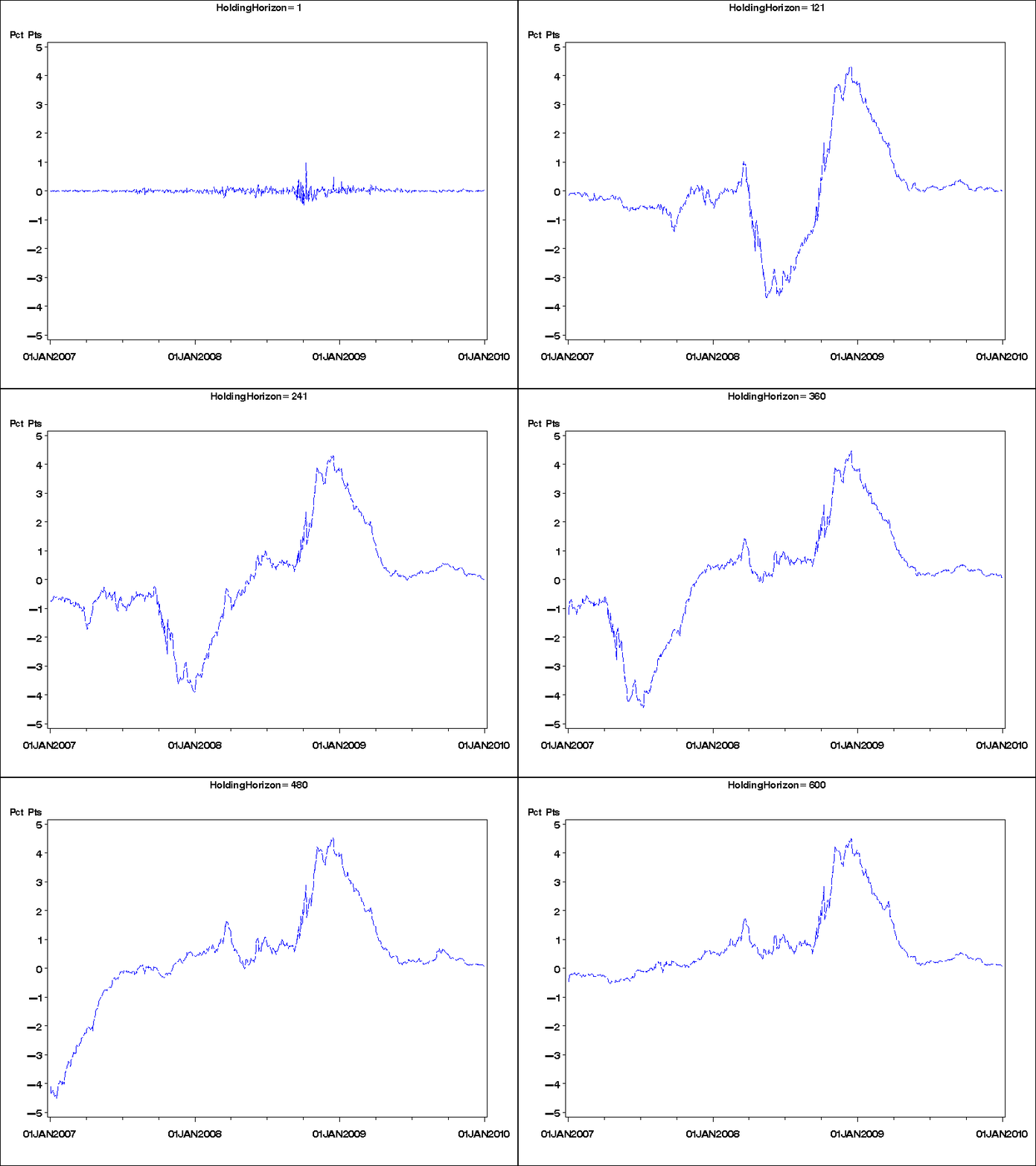
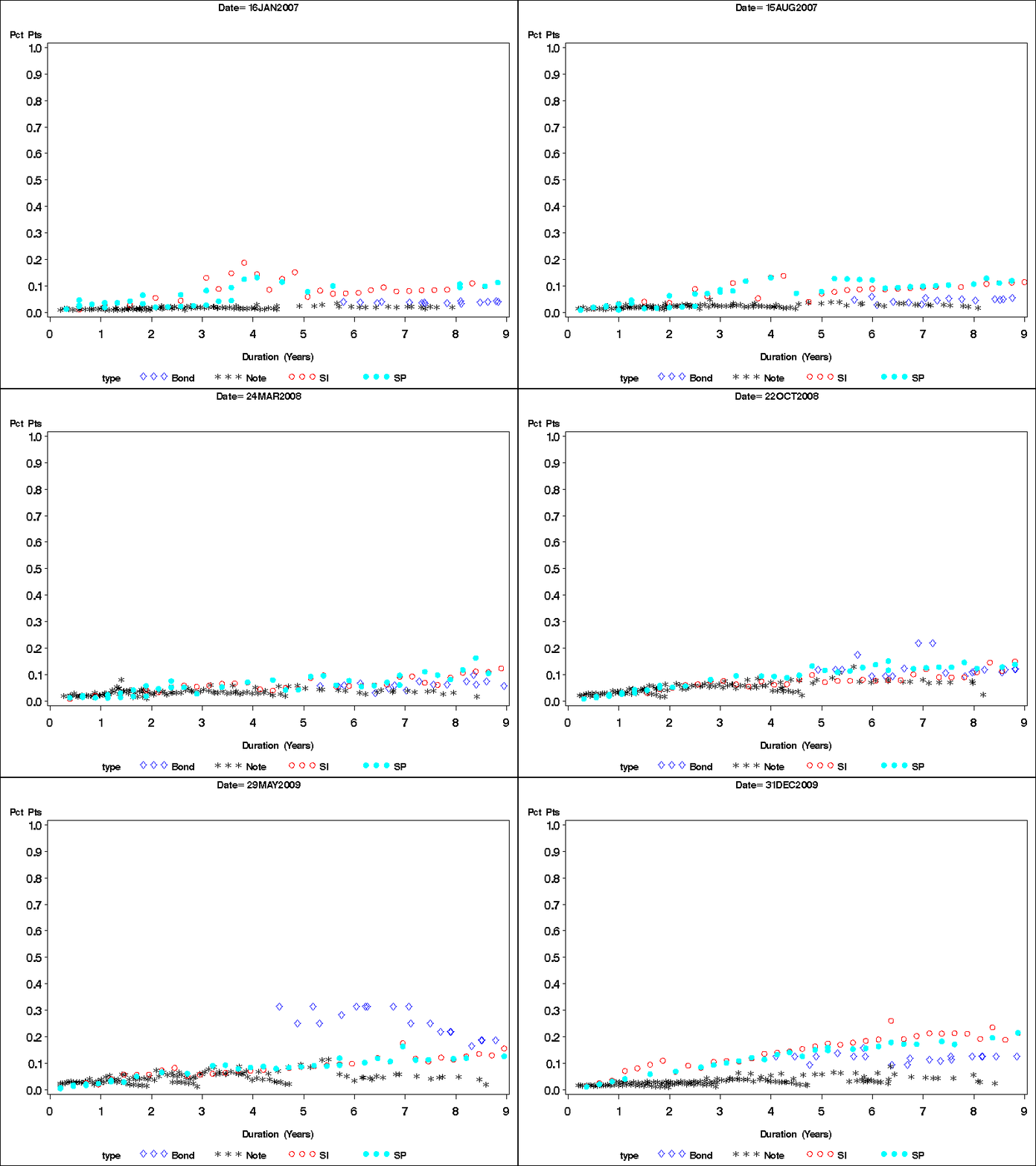
For instance, levered investors' demand for liquid securities contributes to the limits to arbitrage in fixed income markets. When leverage constraints are tightened, the frequency of trading in already liquid securities increases, widening the risk wedge between more- and less-liquid securities, thus allowing a relative price differential to arise and persist.
- ANIMATION: U.S. Treasury yields split into two separate curves (liquid versus illiquid securities) in 2008-2009.
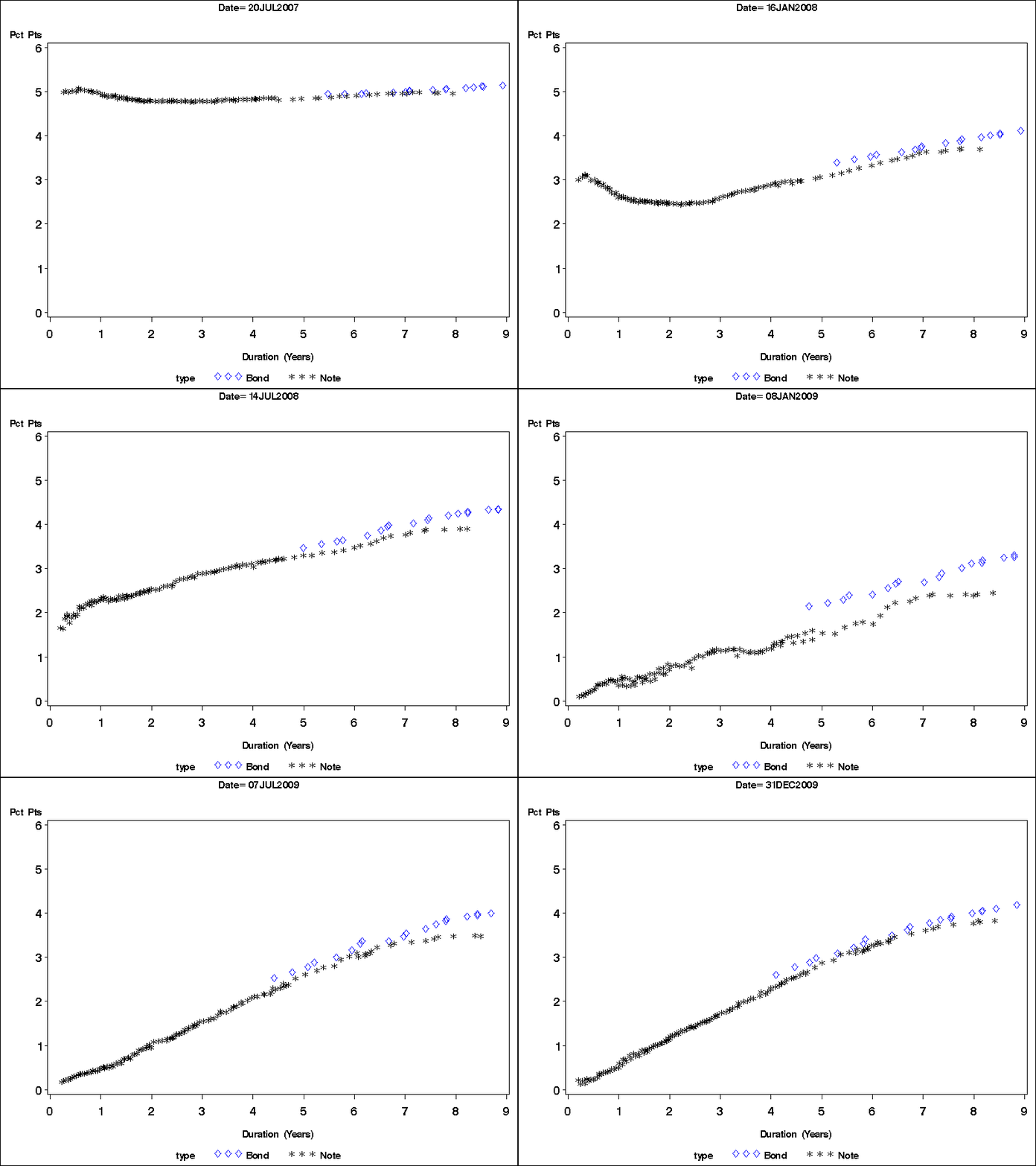
The dynamics of this feedback loop are driven by the interaction between the liquidity risk pricing of investors with heterogeneous security preferences (relating holding horizon to asset liquidity) and intermediaries facing inventory risk. Liquidity feedback between risk pricing and security characteristics gives a possible mechanism for multiple liquidity equilibria.
Mind the Gap: Disentangling Credit and Liquidity in Risk Spreads (Schwarz, 2019, Review of Finance, 23(3): 557-597.)
In the Eurozone sovereign debt markets, I find that the role of liquidity risk in asset prices can be large, and it varies over time and in the cross section. This argues in favor of including a liquidity factor in asset pricing models.
In the Great Financial Crisis, liquidity risk explained more than one third of the average trough-to-peak sovereign bond yield spread widening. During the Sovereign Debt Crisis, the balance of risks shifted to credit. Interestingly, bond market liquidity is the largest contributor to interbank rates over both sample periods. This supports interpreting the market liquidity premia of a security as being closely linked to its funding value as collateral.
My work also contributes methodologically to risk premium estimation. The method of estimating risk premia can importantly determine whether a candidate asset pricing model is rejected or not.
Using Stocks or Portfolios in Tests of Factor Models (Ang, Liu, and Schwarz, 2020, Journal of Financial and Quantitative Analysis, 55(3): 709-750.)
In the standard two-stage Fama MacBeth framework there is a tradeoff in using individual test assets versus portfolio groupings of assets to estimate factor risk premia.
In simulations, the mean square error (MSE) of risk premium estimates shows that using a small number of portfolios gives little benefit to bias and sacrifices much in terms of efficiency. Using a larger number of portfolios (at least 250) achieves the minimum MSE in some data settings, but the tradeoff shifts to favor using individual assets as the likelihood of incorrect portfolio assignment increases (e.g. due to sorting on estimated betas).
- Assets are typically grouped into portfolios. The motivation for this is to increase the precision of the factor loading estimates. Since factor loadings are estimated with error, it makes sense that idiosyncratic error should be increasingly diversified away as more estimates are grouped into each portfolio.
- On the other hand, individual test assets give the full cross section of information in the risk premium estimation, increasing efficiency. Also, there is no risk of mis-assigning asssets into portfolios, which could actually worsen bias.